Bordeaux 2012 – my top 150 wines
April 26th 2013, by Gavin
Here are my scores (out of 100) and estimated maturity dates on the top 150 red wines from the seven main appellations – Pomerol and St-Emilion on the Right Bank, Pessac-Leognan to the south of Bordeaux on the Left Bank, and Margaux, St-Julien, Pauillac and St-Estephe in the Medoc, also Left Bank.
These scores will be on Livex and in an article on the primeurs for Harpers Wine and Spirit magazine. The price is my estimate for a case of 12, in Bond (ex-VAT), as offered by specialist UK wine merchants.
Bordeaux 2012 – vintage summary & my top 40
April 26th 2013, by Gavin
This article was posted today on Livex, the fine wine exchange.
I’ve tasted over 500 Bordeaux wines from the 2012 vintage in April.
Key points about Bordeaux 2012
1. 2012 is a good to very good vintage, but not a great one.
2. It’s certainly a vintage for drinking, not investment. Many wines will be good to drink in the short to medium term.
3. 2012 was a late harvest which tended to favour the earlier ripening Merlot over the Cabernets, partly because drizzle, humidity and finally heavy rain set in from the second week of October onwards.
4. It’s an uneven vintage but hundreds of reds have lovely colour, supple fruit, crowd-pleasing texture and no hard edges.
5. Happily, very few wines show any green, unripe character. The fruit is ripe (thanks to ten weeks of sunshine from mid-July onwards) even if many wines lack real depth, complexity and length.
Bordeaux 2012 – weather report
April 22nd 2013, by Gavin
The Bordeaux 2012 en primeur or ‘futures’ campaign has kicked off. Over the last month, wine merchants and press from around the world have been in Bordeaux for the annual tastings of young barrel samples, and opening prices for some of the leading wines have started to trickle out.
Here is my Bordeaux 2012 weather report, which provides an important background to the character of the vintage. The following is a slightly updated version of the one that was published a fortnight ago by Jancis Robinson and Livex. (Included here are daily tracking graphs for June, July and August which I’ve just compiled, and some photos.)
I’ll follow up with my thoughts on the wines.
I wrote three 2012 harvest reports for Jancis’s site entitled ’Scorching summer but no rush’ last August, followed by ’The Late Show’ in October and lastly ’The end in sight at last’. Given these headlines, you’d be right in thinking that it was a late harvest. What was largely missing from those articles were some weather statistics, so here they are in a graphical format.
After the two outstanding vintages of 2009 and 2010, it’s only normal that onlookers will compare 2012 with 2011. Yet the weather conditions in 2011 and 2012 could hardly have been more different, even if we like to slot two years into the same bracket of ’good but not great’.
12 WEATHER HIGHLIGHTS IN 2012
1. A late bud-burst and a wet April meant a slow start – the opposite of 2011.
2. Mildew was a real threat and had to be kept in check.
3. Mixed weather in June resulted in the flowering being drawn out.
4. Bordeaux enjoyed an excellent summer from mid-July to late September.
5. August was dry and hot but veraison (when grapes change colour) was spread out.
6. The dry whites were picked in fine September weather.
7. The weather changed towards the end of September, and October was up and down.
8. Humid, drizzly weather from 6 October ’encouraged’ many to pick.
9. Expensive grape-sorting machines earned their keep.
10. Sauternes had a challenging year, after three great vintages.
11. Yields were low but not as bad as other parts of France.
12. Quality is uneven and there should be some very good wines.
THE WEATHER CHARTS
1. Late winter, late season
Chris Evans in Bordeaux, Part One
March 19th 2013, by Gavin
Chris Evans, host of BBC Radio 2’s Breakfast Show, came to Bordeaux earlier this month with his lovely wife Natasha for an extensive wine tour. We were honoured to be asked to show them around, via a friend of a friend, and here’s what we got up to, along with some holiday snaps. (To enlarge any picture, click on it.)
“I beg you, if you like wine, take a plane, hire a car and go to Bordeaux,” Chris wrote in his weekly column for The Mail on Sunday, tapped into his Blackberry at his hotel in St-Emilion after just a couple of days here. “It’s a dream trip.”
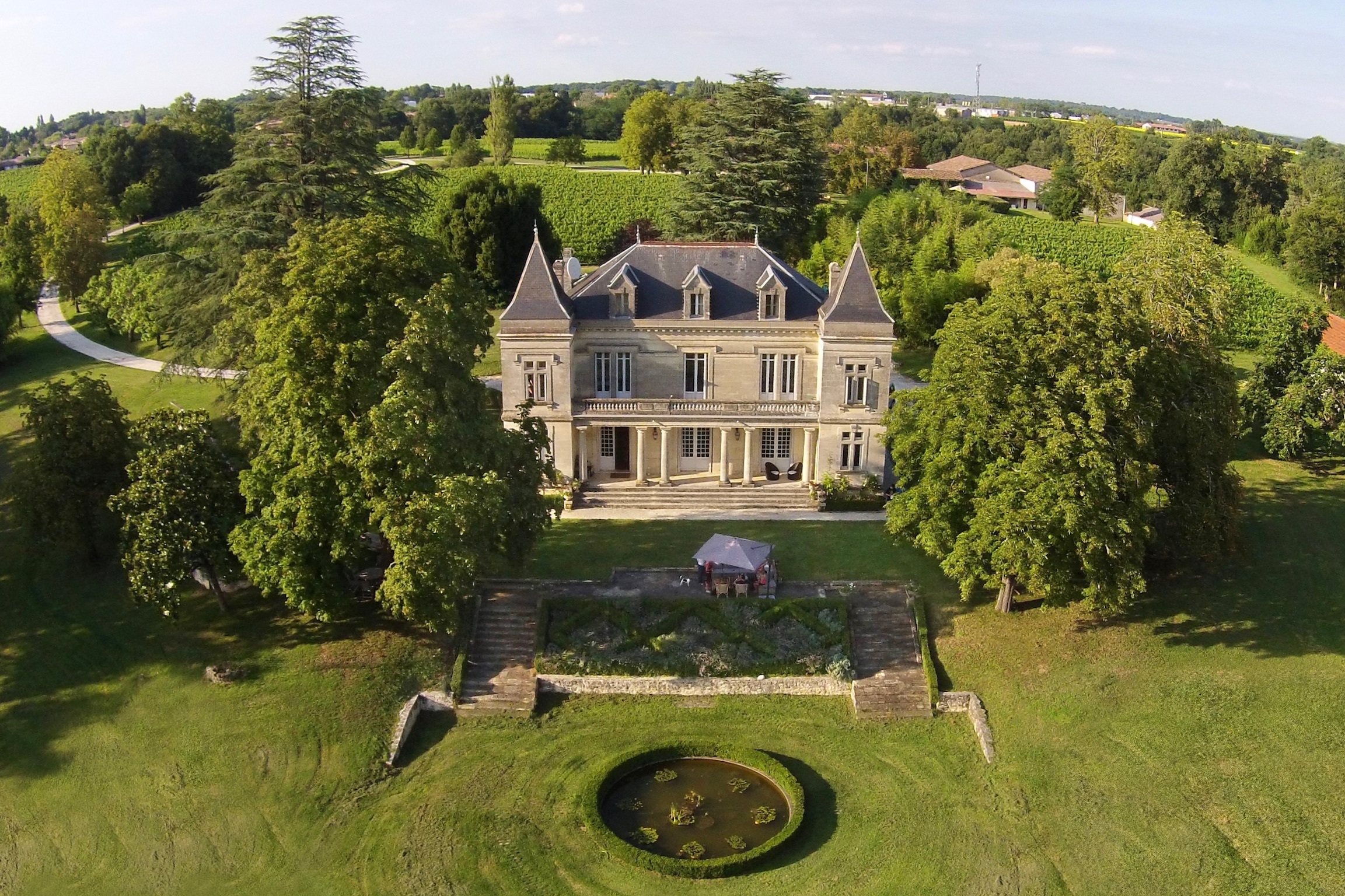
On their ’kids-free wine tour’, we visited Chateau Clinet and Le Pin in Pomerol, Chateau Haut-Brion in Pessac, Chateau Pichon Longueville Baron in Pauillac and Cos d’Estournel in St-Estephe. We also tried a few wines from around the region over dinner here at Chateau Bauduc, at restaurant La Tupina in Bordeaux and in the two restaurants at Les Sources de Caudalie, the hotel set amongst vines to the south of the city.
“Twas fanbloodytastic” he texted when he got home, before appearing on Friday evening’s The One Show on the beeb. He looked fine. I was bloody exhausted.
Then, on Monday, the reality check. “Just been to gym. Nearly died. Holidays not worth the relapse,” he announced on Twitter. (Apparently, he’d put on half a stone.) The trouble with an excursion to this corner of France is that the wine and food can be a little too tempting.
Chris Evans in Bordeaux, Part Two
March 19th 2013, by Gavin
Chris Evans, host of BBC Radio 2’s Breakfast Show, came to Bordeaux earlier this month with his lovely wife Natasha for an extensive wine tour. Here’s what we got up to, along with some holiday snaps. (To enlarge any picture, click on it.)
Tuesday: Chateau Haut-Brion
From Libourne, it was 45 minutes to Chateau Haut Brion in Pessac. It’s a bizarre setting for one of the world’s most famous wines, first mentioned in English by Pepys in seventeenth century London. A wonderful old, gravelly vineyard, with a beautiful old chateau, set in the ugly, modern outskirts of Bordeaux, with a TGV train line cutting through the middle of it.
All visitors are greeted with a video, which is really a collection of pretty photographs, set to relaxing classical music and a voiceover by the owner, Prince Robert of Luxembourg. ’I doubt they’ll put you in front of the video,’ I said, ’but they just might.’ They did. It was dangerously soporific.
After this rather touristy introduction to such a wonderful estate, our guide Laëtitia looked after us very well.
Two of the more interesting aspects of the tour at Haut-Brion is the lab, where some returned ’corked’ bottles of wine were being analyzed, and the in-house barrel maker. Unfortunately the cooper wasn’t there, but we saw a great many of his barrels.
Wine Duty £2 a bottle, up 50 percent in 5 years
March 18th 2013, by Gavin
‘No further changes to alcohol duty’ is the usual line from George Osborne in his Budget speech. Don’t be fooled: with the Government’s duty escalator in place, wine duty will hit £2 a bottle, up 50% in 5 years. With 20% VAT on wine and duty, exactly 50% of a £6 bottle will be tax.
If you like wine from Europe, my little graph says it all.
Feel free to leave a comment, or share this on Twitter or Facebook below. Thanks.
March Newsletter
March 17th 2013, by Gavin
If you would like to be kept up to date via our monthly newsletter, simply type in your first name and email address below:
Click on the newsletter image to open any of the links:
Pulling the cork on the Single Market
January 28th 2013, by Gavin
Listening to David Cameron’s important speech on Europe last week, anyone at the sharp end of the UK wine business must have raised a quizzical eyebrow at his unqualified support for the Single Market. In contrast to his laudable vision, tax on wine in the UK is completely out of line with other countries in the EU, and the gap is widening.
’So let me set out my vision for a new European Union, fit for the 21st Century,’ the Prime Minister said on 22 January.
’It is built on five principles. The first: competitiveness. At the core of the European Union must be, as it is now, the single market. Britain is at the heart of that Single Market, and must remain so…
’It is nonsense that people shopping online in some parts of Europe are unable to access the best deals because of where they live. I want completing the single market to be our driving mission.’
So why, then, is wine taxed so heavily in Britain compared to the continent?
As things stand, and it will be interesting to see what transpires when the Government’s consultation period on its alcohol strategy ends on 6 February, UK duty will hit £2 a bottle in the Budget on 20 March.
That’s 50% up from £1.33 in five years, whereas in the eight years before that it nudged up a respectable 15%. Duty on sparkling wine, including the now fashionable fizz made in England, will be around £2.55 a bottle. (We can bank on these figures, currently £1.90 and £2.43, because the Chancellor has persisted with the duty escalator that Labour introduced in 2008.)
Then there’s the double whammy of VAT on the duty as well as the wine, so the real duty cost will be £2.40 and £3 a bottle, for still or sparkling. And that’s without including the margin that retailers, merchants, pubs and restaurants have to add on top: believe it or not, duty costs more than the wine itself for the vast majority of bottles sold in the UK (that’s on anything under £7 retail – the average is a fiver – or £17 or so in a restaurant).
Meanwhile, and here’s the rub, there is no duty at all on still wine in 17 EU countries, including Germany, Italy, Spain, Portugal and Austria. In France, it’s 3p. To quote the Prime Minister’s fifth principle – fairness – how fair is this for Britain?
25 Tips on How to Serve Wine
December 18th 2012, by Gavin
Time to dust down the glasses, get the decanter out and root around for those special bottles in the garage, the cellar, the wine rack or in the cupboard under the stairs. Whatever you’re drinking, here are some tips on how to get the most from your wine this Christmas.
If you don’t have any of the items in bold, you might want to add them to your Christmas list.
Which glasses?
1. Good wine glasses are important, and are usually tulip-shaped. (There are exceptions, such as the more angular Zalto.) The best are made of fine glass but they don’t have to be really expensive – the three on the left of the photo below cost under a fiver each.
10 Books for Wine Lovers
December 18th 2012, by Gavin
Forget silly gadgets and dodgy bottles of spirits. Wine people like to be given wine. And wine books. (Ange likes Hendricks Gin, by the way.) Here’s a list of this year’s best publications which you can still grab in time for Christmas, albeit not from us. Santa, Amazon..
All were published in 2012.
Wine Grapes by Jancis Robinson, Julia Harding and José Vouillamoz
£120 rrp, £77 on Amazon or elsewhere here. Fascinating for wine geeks but it’s probably not one for the casual reader and it isn’t in the bargain basement. As it says on the cover: ’A complete guide to 1,368 grape varieties, including their origins and flavours.’ (Can you name one of the 22 varieties that start with Z?) It’s hard to think of a more important or thoroughly researched opus on wine. I’m looking forward to getting to stuck in after Christmas.
Bordeaux Legends by Jane Anson
£35 rrp, £31.50 on Amazon. We loved this stunning book on the Bordeaux First Growths by our friend Jane Anson, the Bordeaux correspondent for Decanter magazine, so much that we pre-ordered 35 signed copies for Bauduc Bondholders and Club Members. We were totally oversubscribed in the space of two days. It won’t be available in the UK until the Spring, so we’ll keep you posted, but it’s only fair to include it in our list of favourite wine books from 2012.